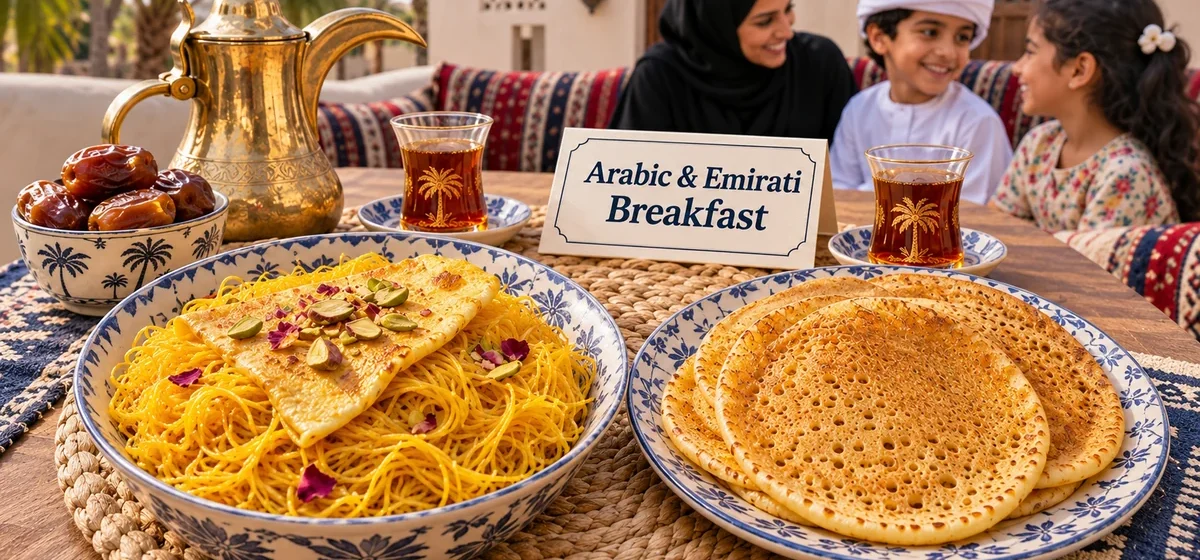
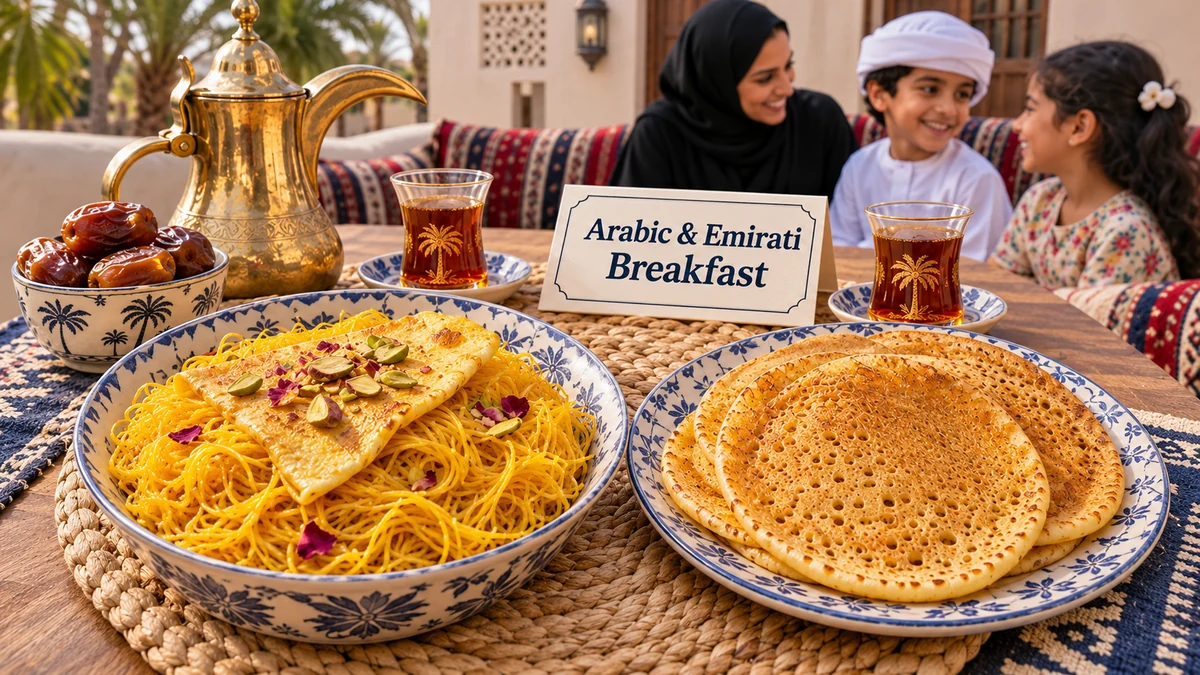
A traditional Arabic breakfast in the UAE brings 5 to 10 small dishes to the table at once, eaten with bread and dates, plus Arabic coffee or sweet tea. The Emirati version leans sweet and spiced, with saffron vermicelli and cardamom pancakes. Tables from the Levant add beans and cheese, with za'atar bread on the side.
These breakfasts are slow. Shared, too. With National Day on 2 December and Ramadan close behind, this is the season to learn them. Nobody gets a plate of their own, and bread doubles as the spoon. To learn the dishes with a chef, Pursueit lists cooking classes in Dubai by cuisine and date.
This guide lists 12 dishes, gives 3 simple recipes for home, and covers where to try an Arabic breakfast in Dubai.
Middle Eastern cooking classes
Swipe or scroll to compare classes.
What Is a Traditional Emirati Breakfast?
A traditional Emirati breakfast centres on balaleet, a sweet saffron vermicelli topped with a thin omelette, and chebab, small cardamom pancakes served with date syrup. Khameer or regag bread, boiled chickpeas called dango, fresh dates and Arabic coffee fill out the table. Families often add eggs with tomato or cheese.
Spice runs the show. Saffron and cardamom turn up in sweet and savoury dishes alike, which surprises visitors who expect salt in the morning.
| Dish | What it is | Sweet or savoury | Eaten with |
|---|---|---|---|
| Balaleet | Sweet saffron vermicelli under an omelette | Both | Eaten alone, with a spoon |
| Chebab | Yeasted pancakes flavoured with cardamom and saffron | Sweet | Date syrup and cheese |
| Khameer | Soft, slightly sweet bread, sometimes with fennel seeds | Sweet | Cheese, honey or date syrup |
| Regag | Paper-thin crisp bread cooked on a hot plate | Savoury or sweet | Egg, cheese or a sweet spread |
| Dango | Boiled chickpeas with cumin and chilli | Savoury | Lemon and black pepper |
| Foul medames | Slow-cooked fava beans, garlic, lemon, olive oil | Savoury | Pita and raw onion |
| Manakish | Flatbread baked with za'atar and olive oil | Savoury | Tomato, cucumber, mint |
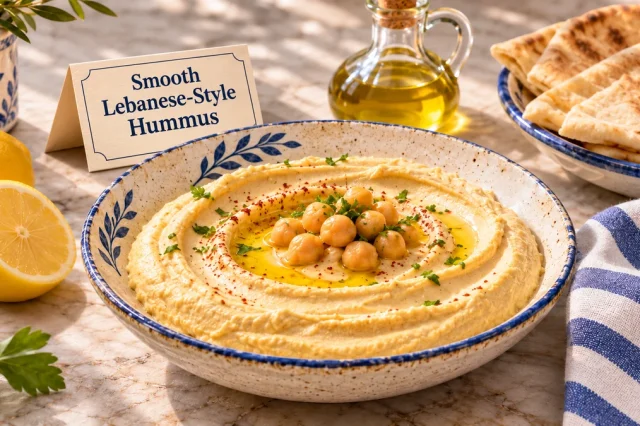
| Labneh | Thick strained yoghurt | Savoury | Olive oil, olives, bread |
| Fatteh | Toasted bread under chickpeas in yoghurt | Savoury | Eaten warm, as a dish of its own |
| Shakshuka | Eggs poached in spiced tomato sauce | Savoury | Bread for dipping |
| Halloumi | Grilled or fried firm cheese | Savoury | Watermelon or tomato |
| Ka'ak | Sesame bread ring, sold from street carts | Savoury | Za'atar or cheese |
What Do Arabs Eat for Breakfast?
Arabs eat very different breakfasts depending on the region. Gulf families start with sweet dishes and dates, washed down with coffee. Breakfasts in Lebanon and Syria focus on beans, cheese, yoghurt and herbs. Egyptian tables are built around foul. Bread and olives sit on almost every one.
Across the Arab world, breakfast is also the meal most often eaten outside. Street carts sell ka'ak and manakish to people on their way to work. Friday breakfast with the wider family can stretch well past noon in many UAE homes, long after the coffee pot has been refilled and the children have left the table.
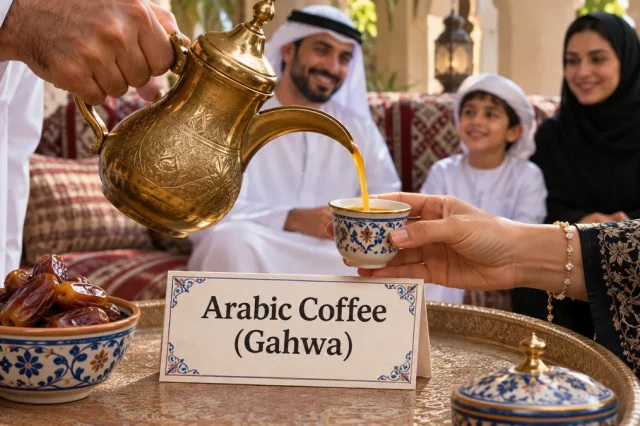
Coffee differs too. Gulf Arabic coffee is light, spiced with cardamom and poured in small cups with dates. Homes in the Levant more often drink sweet tea with mint or a darker, thicker coffee boiled with sugar.
How Do You Cook 3 Simple Arabic Breakfast Dishes at Home?
Three Arabic breakfast dishes are easy for a first try at home. Balaleet and chebab come from the Emirati table, and foul medames from the Levant. Each needs under 40 minutes and ingredients sold in any Dubai supermarket. The first two are sweet. Foul gives a savoury plate to share.
Recipe 1: Balaleet (serves 4)
| Ingredient | Amount |
|---|---|
| Thin vermicelli | 200 g |
| Butter or ghee | 2 tbsp |
| Sugar | 4 to 5 tbsp |
| Saffron, soaked in 2 tbsp warm water | A pinch |
| Ground cardamom | 1/2 tsp |
| Rose water | 1 tsp |
| Eggs | 3 |
- Toast the vermicelli in the butter for 3 minutes until golden.
- Add 500 ml water and simmer for 6 to 8 minutes until soft. Drain off any extra.
- Stir in the sugar and saffron water, then the cardamom and rose water. Keep warm.
- Beat the eggs with a pinch of salt and cook a thin omelette.
- Serve the vermicelli in a bowl, with the omelette laid over the top.
Recipe 2: Chebab (makes 12)
| Ingredient | Amount |
|---|---|
| Plain flour | 250 g |
| Instant yeast | 1 tsp |
| Sugar | 2 tbsp |
| Ground cardamom | 1 tsp |
| Saffron, soaked in warm water | A pinch |
| Egg | 1 |
| Warm milk | 300 ml |
Whisk everything into a smooth, thick batter and leave it for 45 minutes until bubbly. Heat a non-stick pan on medium. Pour in small rounds, about 10 cm across, and cook until bubbles cover the top, about 2 minutes, then flip for 30 seconds. Serve warm with date syrup and soft white cheese.
Recipe 3: Foul medames (serves 4)
Drain two 400 g tins of fava beans and warm them with 100 ml water for 10 minutes. Mash roughly. Stir in 2 crushed garlic cloves, the juice of 1 lemon, 1 tsp cumin and salt. Pour over 3 tbsp olive oil and top with chopped parsley and tomato. Eat with warm pita. That is breakfast for four in half an hour, with almost no washing up.
Want to cook a Levantine spread with a chef?
The Vegetarian Lebanese Feast at Latifa Tower on Sheikh Zayed Road costs AED 375 for one session on Pursueit, for ages 16 and up.
Book the Lebanese ClassWhere Can I Try a Traditional Arabic Breakfast in Dubai?
The best-known place to try an Emirati breakfast is the cultural meal at SMCCU in Al Fahidi, where guests sit on floor cushions in a courtyard for 90 minutes. The centre also serves a light breakfast with Arabic coffee at its Jumeirah Mosque visits. Old Dubai cafes in Al Fahidi and Al Seef serve Emirati plates too.
For an Arabic breakfast Dubai locals grab on the go, look for Lebanese bakeries selling manakish and ka'ak from early morning. Satwa and Karama have several, and a za'atar manoushe usually costs less than a coffee.
Hotels across the city run weekend Arabic breakfast spreads. They suit groups and visitors who want to try many dishes at once. Book ahead.
A cooking class goes further than a restaurant. Much further. Cooking one dish yourself shows how the spices layer, and the recipe comes home with you. Pursueit lists an arabic cooking class dubai page with Lebanese and Moroccan sessions.
| Middle Eastern class on Pursueit | Where | Age | Price |
|---|---|---|---|
| Vegetarian Lebanese Feast | Latifa Tower, Sheikh Zayed Road | 16+ | AED 375 for 1 session |
| Moroccan Cooking Class | Palm Jumeirah Mall | 14+ | AED 499 for 1 session |
| The Levantine Feast: Private Culinary Class | Cluster I, JLT | 14+ | AED 840 for 1 session |
No Emirati-only class is listed yet. The Lebanese and Levantine sessions cover the savoury half of the table, from labneh to fatteh.
Prefer a private class for family or friends?
The Levantine Feast private class in JLT costs AED 840 for one session on Pursueit, for guests aged 14 and up.
Book a Private ClassWhere Can You Taste Emirati Food at UAE Events This Winter?
Sheikh Zayed Festival in Al Wathba, Abu Dhabi, runs until mid-March 2027 for AED 10 a ticket, with heritage food stalls every evening. Global Village Season 31 is open in Dubai, and UAE National Day on 2 December brings Emirati dishes to homes and schools. Ramadan, expected from 8 February 2027, turns breakfast into suhoor.
| Event | Dates | Where | What to eat |
|---|---|---|---|
| Sheikh Zayed Festival | 30 October 2026 to 14 March 2027, from 4pm | Al Wathba, Abu Dhabi | Luqaimat with gahwa at the heritage village |
| Global Village Season 31 | From 14 October 2026 | Dubailand, Dubai | Emirati and Levantine street food |
| UAE National Day | Wednesday 2 December 2026 | Across the UAE | Balaleet and chebab at home |
| Ramadan (expected) | From about 8 February 2027 | Across the UAE | Foul and labneh at suhoor |
National Day is the easiest win. Cook balaleet on the morning of 2 December, set out dates and gahwa, and the table looks like an Emirati home.
Suhoor is different. Families eat it before dawn, so the dishes lean filling and slow. Beans and eggs win over sweets.
Learn to cook a Levantine spread
Swipe or scroll to compare classes.
Frequently Asked Questions
1. What is the most popular Arabic breakfast dish?
Foul medames is probably the most widely eaten, from Cairo to Amman to Dubai. It takes about 10 minutes from a tin and costs very little. At home in the UAE, balaleet runs a close second, especially on Fridays and during Eid, when families cook bigger breakfasts for guests.
2. Is Arabic breakfast healthy?
Much of it is. Beans and chickpeas give protein and fibre, and olive oil with fresh herbs rounds out the plate. The sweet Emirati dishes carry more sugar, so balance one portion of balaleet or chebab with eggs and salad. A table of 6 small dishes shared between 4 people keeps portions sensible.
3. What is the difference between Emirati and Lebanese breakfast?
Emirati breakfast leans sweet and spiced, built on saffron vermicelli and cardamom pancakes. Lebanese breakfast is mostly savoury, with manakish, labneh and foul. Both share bread and olives, and a full Emirati table often runs to 8 or more dishes. In Dubai, you will often see both on the same hotel breakfast spread.
4. Can I make an Arabic breakfast in 30 minutes?
Yes. Warm a tin of foul, set out labneh with olive oil and toast pita with za'atar, then add a pot of mint tea. That spread takes about 20 minutes. Balaleet takes 25 minutes more, so save it for a weekend morning when there is time.
5. What do you drink with an Emirati breakfast?
Arabic coffee, or gahwa, is the classic drink. It is light, spiced with cardamom and sometimes saffron, and served in small cups with dates. Sweet karak tea with milk is also common at breakfast in Dubai, especially at roadside cafeterias, where a cup costs about AED 1 to AED 2.
Ready to Book?
Try one recipe this weekend, then learn the rest of the table with a chef. Middle Eastern cooking classes on Pursueit start from AED 375 a session.
Browse Cooking Classes