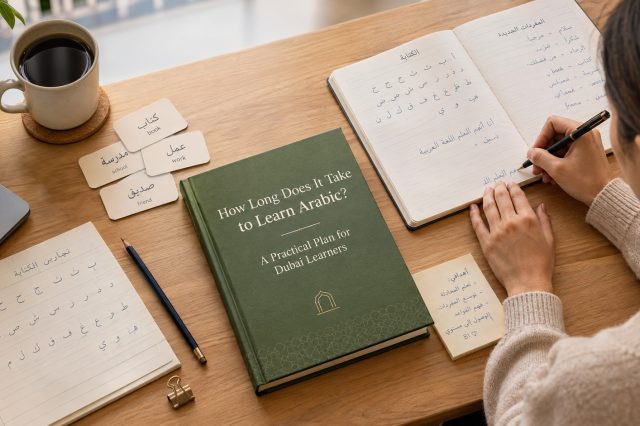

The Arabic alphabet for beginners is the first decision point in Arabic learning: should you learn the script before joining a course, or let the course teach it? The practical answer is that 2 to 3 weeks of independent alphabet study before your first group class produces meaningfully better early-course outcomes. Students who arrive able to read basic Arabic text process vocabulary faster, connect spoken and written forms earlier and spend less cognitive energy on decoding. This guide covers the Arabic alphabet for beginners in practical terms: structure, which letters to prioritize, pronunciation notes and which learning goal determines how much time to invest. Book an Arabic course on Pursueit once you’ve completed this primer.
The Structure of the Arabic Alphabet
Arabic letters for beginners: Arabic has 28 letters, all consonants. The vowel system in everyday Arabic text is typically omitted; short vowels appear as small diacritical marks in beginners’ texts but not in adult Arabic. This means Arabic reading practice for beginners involves learning to infer vowels from context, a skill that develops with exposure rather than rules.
The 28 letters reduce to 17 distinct shapes. Many letters share a base shape and are distinguished only by the number and position of dots. Arabic reading practice for beginners is made significantly easier by learning dot patterns alongside base shapes rather than treating each letter as completely separate, this reduces the memorization load by roughly 40% compared to learning each letter as an isolated unit.
Arabic is written right-to-left. Letters connect to each other within words, and most letters take different forms depending on their position: initial (start of word), medial (middle), final (end) and isolated. Six letters do not connect to the following letter, which means the following letter always uses its initial or isolated form even in the middle of a word.
Arabic Letters for Beginners: Grouped by Shared Shape
Arabic letters for beginners are most efficiently learned in groups of shared base shapes rather than in alphabetical order:
- Group 1 — Single stroke with dots: Ba (ب one dot below), Ta (ت two dots above), Tha (ث three dots above). Same base stroke, three sounds distinguished by dots only. Master the base stroke once, then learn the dot patterns.
- Group 2 — The J family: Jeem (ج one dot below), Ha (ح no dots), Kha (خ one dot above). Same curved base, three sounds.
- Group 3 — The R family: Ra (ر no dots), Zayn (ز one dot above). Same small curve, two sounds.
- Group 4 — The S family: Seen (س no dots), Sheen (ش three dots above). The zigzag pattern that beginners find most distinctive in Arabic letters for beginners.
- Group 5 — Emphatic consonants: Sad (ص no dots), Dad (ض one dot above), Ta (ط no dots), Za (ظ one dot above). These are produced with the tongue raised toward the back palate, darkening the vowels around them. Essential for Arabic reading practice for beginners to distinguish between words that look similar but mean very different things.
- Group 6 — The Ayn family: Ayn (ع, no dots, throat constriction sound), Ghayn (غ, one dot above — gentle gargle). Most challenging Arabic letters for beginners phonetically.
- Standalone letters: Meem (م), Nun (ن), Waw (و), Ya (ي), Ha (ه), Alef (ا), Hamza (ء), Lam-Alef combination (لا).
The Six Non-Connecting Letters
Arabic reading practice for beginners is made easier by knowing which letters never connect to the following letter: Alef (ا), Dal (د), Dhal (ذ), Ra (ر), Zayn (ز) and Waw (و). When these appear in the middle of a word, the following letter always uses its initial or isolated form. Recognising this pattern removes a significant source of confusion in early Arabic alphabet study for beginners and makes text parsing noticeably faster.
Pronunciation Notes for Sounds Without English Equivalents
- Ha (ح): A constricted, whispery H produced in the throat, distinct from the soft English H. One of the Arabic letters for beginners most commonly mispronounced as a regular H.
- Kha (خ): Back-of-throat friction like Scottish ‘loch’. Present in khayr and khalas. Do not pronounce as K.
- Emphatic consonants (ص ض ط ظ): Produced with the tongue flat and body raised toward the back palate. Learning to hear the difference between emphatic and non-emphatic versions is central to Arabic reading practice for beginners, distinguishing between words that share the same base letters.
- Ayn (ع): A throat constriction with no English equivalent. Best learned by ear from a native speaker. The Arabic letter for beginners most commonly omitted or incorrectly approximated.
- Ghayn (غ): Gentle gargle similar to French R. Common in everyday words including Ghali (expensive).
Reading vs Speaking: How Much Alphabet Before Your First Course
Arabic alphabet for beginners study before a first course produces different returns depending on your learning goal. If your goal is conversational Gulf Arabic for daily life in Dubai: 1 week of alphabet basics (recognising all 28 letters in isolation) is sufficient before a spoken Arabic class. If your goal is Modern Standard Arabic for reading formal text: 2 to 3 weeks on Arabic letters for beginners before a class produces significantly better early-course outcomes. If your goal is Quranic Arabic for religious practice: alphabet study with diacritical recognition is foundational and should be completed before any formal Quranic study. Arabic reading practice for beginners focused on diacritical recognition is the appropriate pre-course preparation for Quranic goals.
Frequently Asked Questions
How long does it take to learn the Arabic alphabet?
Arabic alphabet for beginners: most adult learners can recognize all 28 letters in isolated form within 1 week of focused daily practice (20 to 30 minutes per day). Reading connected text, where letters take different forms and vowels are omitted, takes 3 to 6 weeks of Arabic reading practice for beginners to reach basic functional speed.
Should I learn the alphabet before starting a class?
For conversational Arabic: 1 week of Arabic alphabet basics for beginners is sufficient. For reading-focused Arabic: 2 to 3 weeks of Arabic letters for beginners study before a class produces significantly better early-course outcomes since you can engage with written materials from session one.
Is the Arabic alphabet covered in Pursueit courses?
The arabic for beginners group course at JLT (10 sessions, AED 1,050) includes arabic alphabet for beginners introduction alongside spoken content. Students who arrive with prior alphabet knowledge progress faster through the literacy components and can dedicate more class time to conversation and grammar.
What is the difference between Arabic letters and Arabic script?
Arabic letters for beginners refers to the 28 individual characters of the Arabic alphabet. Arabic script refers to the full writing system, including connecting forms, positional variants, diacritics and punctuation that appear in actual written text. The arabic alphabet for beginners is the building block; the script is how those letters function together.
Where can I practise the Arabic alphabet in Dubai?
Arabic reading practice for beginners: apps such as Duolingo Arabic for letter recognition, alongside the study materials provided in the Pursueit group Arabic course. The private Arabic online class offers instructor-led pronunciation and literacy support for more targeted arabic letters for beginners correction.
Start your Arabic course with Pursueit — book Arabic classes now